



Canada, China set for ‘historic’ gains from new partnership, Carney says
2 min read



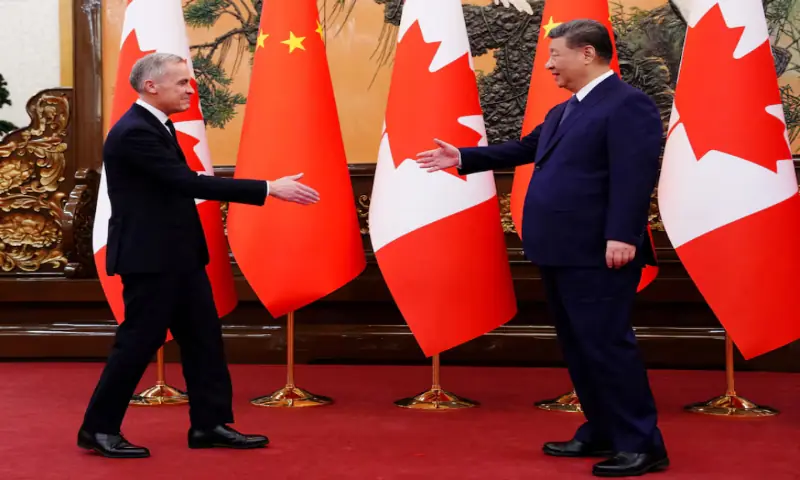
Canada and China are forging a new strategic partnership that promises “historic” gains by leveraging on each other’s strengths, Canadian Prime Minister Mark Carney told Chinese leader Xi Jinping on Friday.
The first Canadian prime minister to visit China since 2017, Carney was on a mission to rebuild ties with Canada’s second-largest trading partner after the United States, following months of diplomatic efforts to resolve earlier tension.
“It is important to start this new strategic partnership at a time of division,” Carney told Xi, calling for focus on areas that can bring “historic gains” for both, such as agriculture, agri-food, energy, and finance.
“That is where I believe we can make immediate and sustained progress,” he added.
Canada is looking to strengthen ties with the world’s second-biggest economy after US President Donald Trump imposed tariffs on some of its goods and suggested the longtime US ally could become the country’s 51st state.
China, similarly hit by Trump’s tariffs since he returned to the White House last year, is also keen to cooperate with a Group of Seven nation in a traditional sphere of US influence.
“I look forward to continuing to work with you, with a sense of responsibility toward history, our peoples, and the world, to improve China-Canada relations further,” Xi told Carney.
Analysts say the rapprochement could reshape the political and economic context in which Sino-US rivalry unfolds, although Ottawa is not expected to dramatically pivot away from Washington.
“Canada is a core US ally and deeply embedded in American security and intelligence frameworks,” said Sun Chenghao, a fellow at Tsinghua University’s Centre for International Security and Strategy.
“It is therefore very unlikely to realign strategically away from Washington.”
But if Ottawa took a more pragmatic and autonomous economic policy toward China, Beijing could point to it as evidence that US-led decoupling was neither inevitable nor universally accepted among America’s closest partners, he added.
Despite the prospects for partnership, some economic and trade issues remain to be resolved.
In 2024, the government of former Prime Minister Justin Trudeau imposed tariffs on Chinese electric vehicles, following similar US penalties.
At the time, Trudeau justified the tariffs on the grounds of unfair global market advantages secured by Chinese manufacturers thanks to state subsidies, a scenario that could hurt Canada’s auto industry.
China retaliated last March with tariffs on more than $2.6 billion of Canadian farm and food products, such as canola oil and meal, followed by tariffs on canola seed in August, leading to a 2025 slump of 10.4% in China’s imports of Canadian goods.
Tariff talks continue, Canada’s industry minister told reporters in Beijing on Thursday.
For the latest news, follow us on Twitter @Aaj_Urdu. We are also on Facebook, Instagram and YouTube.













Comments are closed on this story.