US and Israel launch strikes on Iran, targeting its leadership

Published 28 Feb, 2026 05:09pm 0 min read
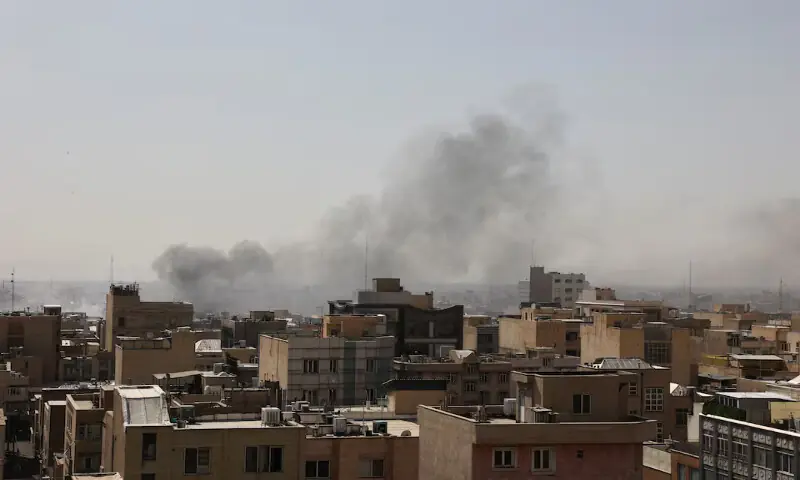
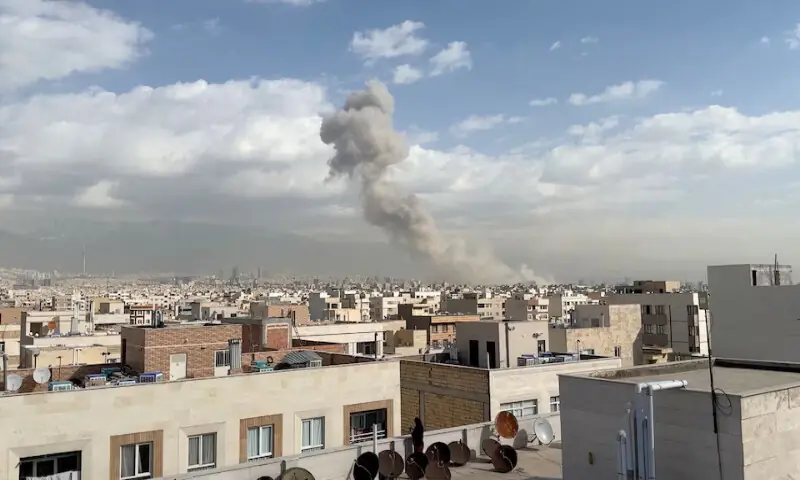
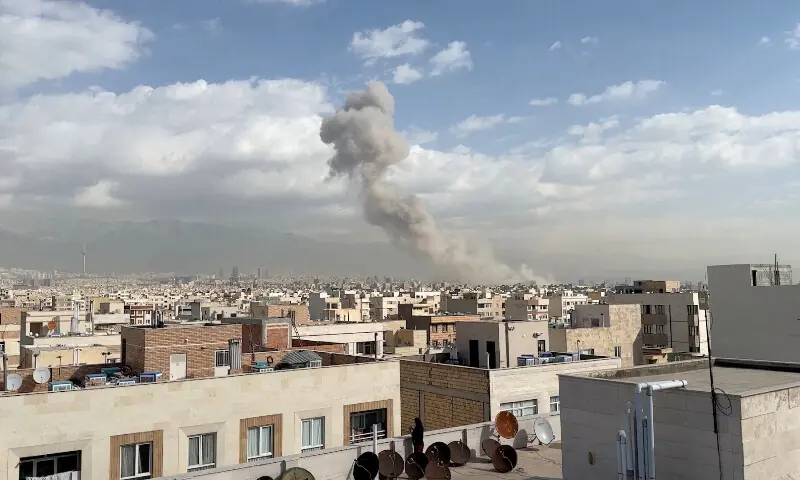
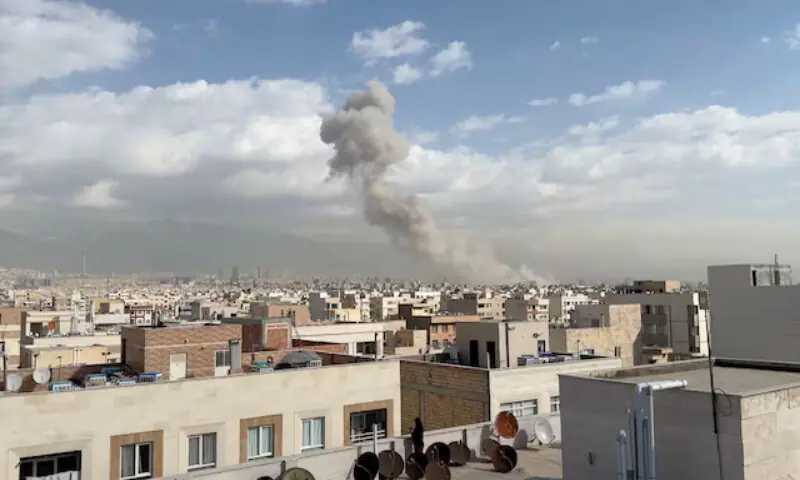
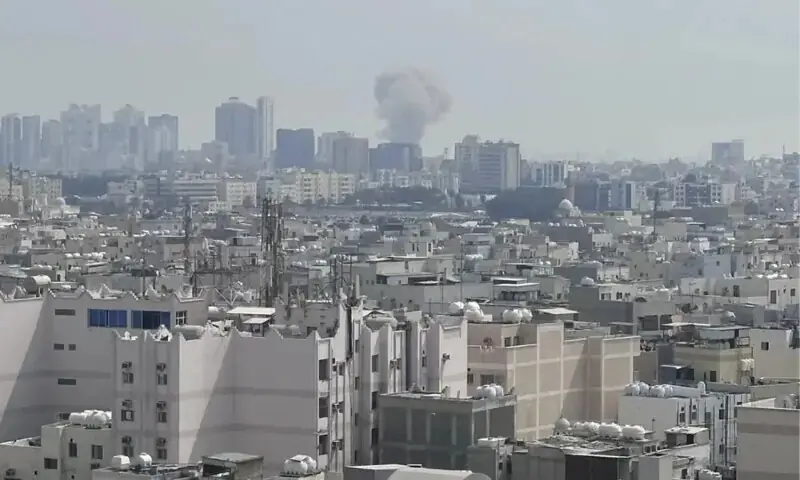
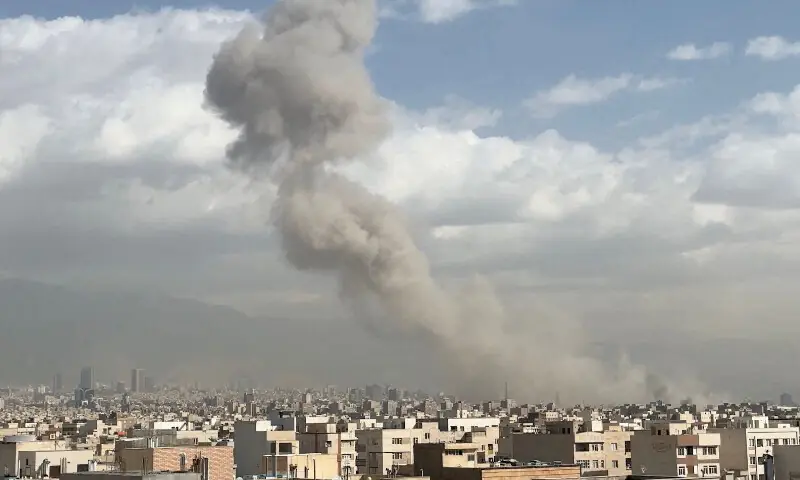
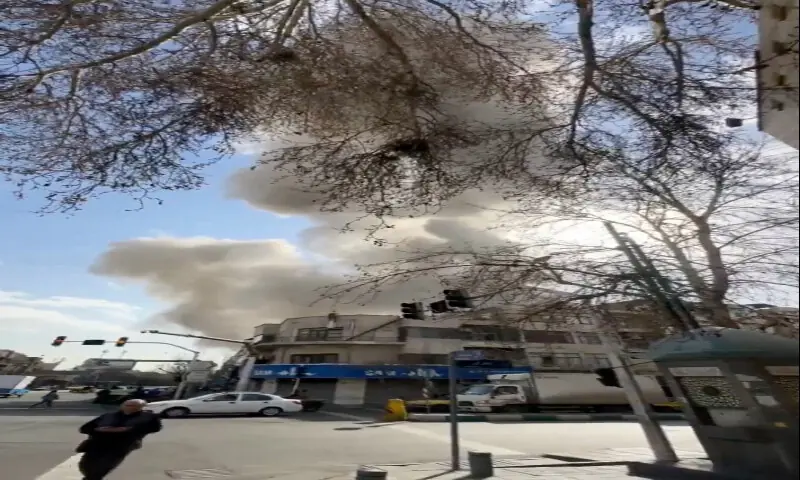
Smoke rises following an explosion after Israel and the US launched strikes on Iran, in Tehran, Iran, on Saturday. – Reuters
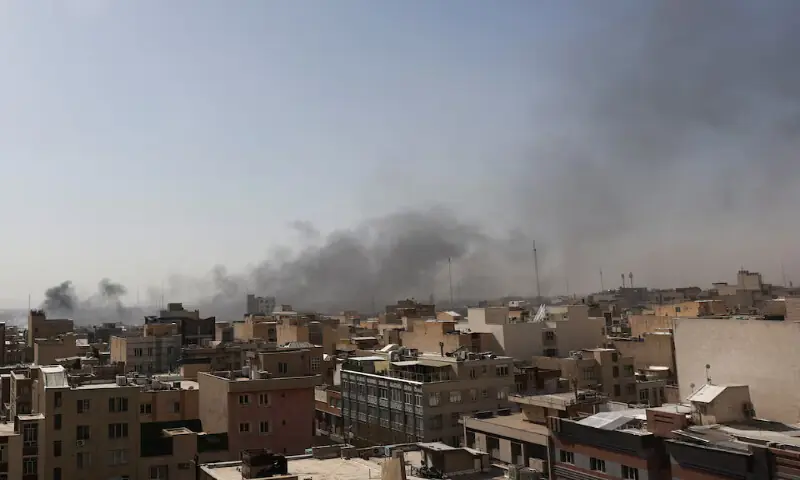
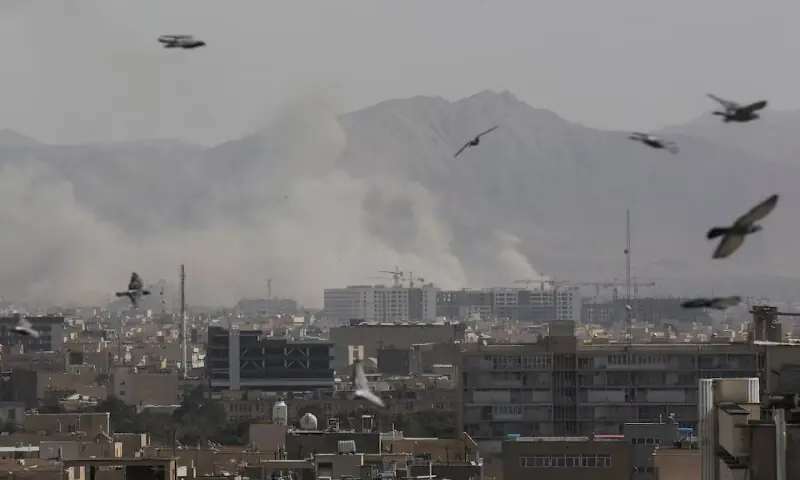
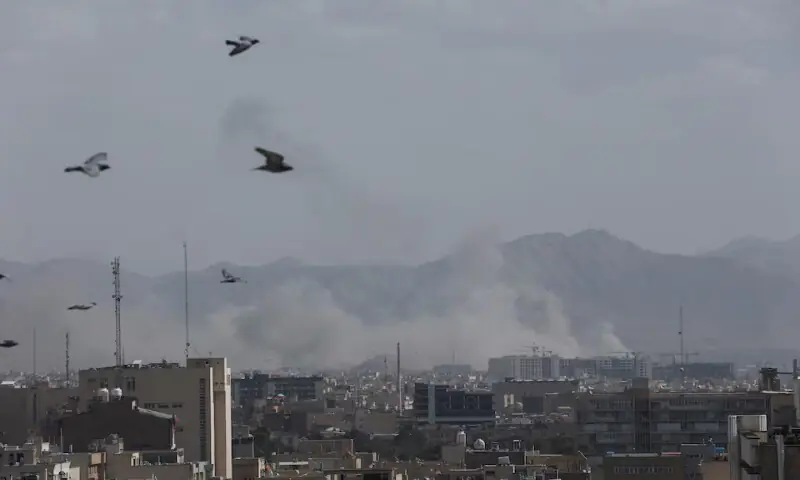
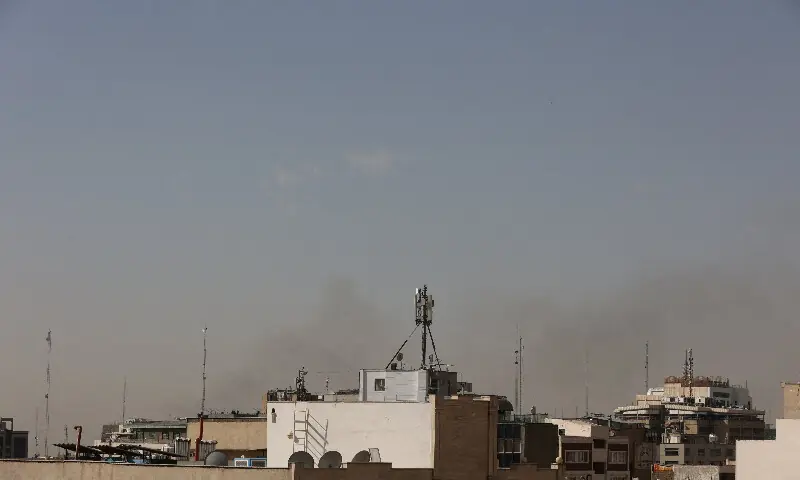
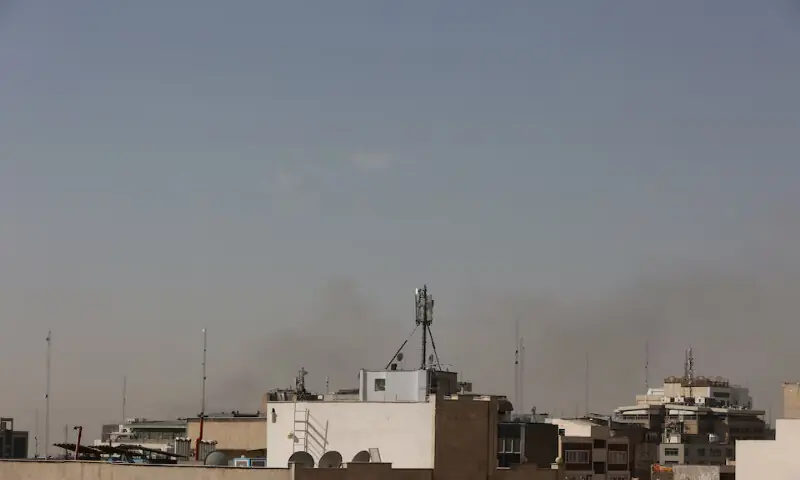
Smoke rises following an explosion in Tehran, Iran, on Saturday. – Reuters

The United States and Israel launched strikes on Iran on Saturday, targeting its leadership and plunging the Middle East into a new conflict that President Donald Trump said would end a security threat to the United States and give Iranians a chance to topple their rulers.

The strikes put nearby oil-producing Gulf Arab countries on edge as fears of escalation in the region grew, and Tehran responded by launching missiles towards Israel.

The first wave of strikes in what the Pentagon named “Operation Epic Fury” mainly targeted Iranian officials, a source familiar with the matter said.

An Israeli official said Iranian Supreme Leader Ayatollah Ali Khamenei and President Masoud Pezeshkian were both targeted but the result of the strikes was not clear.

A source with knowledge of the matter had earlier told Reuters that Khamenei was not in Tehran and had been transferred to a secure location.

An Iranian source close to the establishment said several senior commanders in Iran’s Revolutionary Guards and political officials had been killed.

Reuters could not independently confirm the report.

Hopes dim for diplomatic solution

The renewed confrontation between Iran and its long-time foes dimmed hopes of a diplomatic solution to Tehran’s nuclear dispute with the West.

The latest indirect talks between the US and Iran this week failed to produce a breakthrough.

Iran’s Revolutionary Guards said a first wave of retaliatory Iranian missile and drone attacks had been launched against Israel, and that all US bases and interests in the region were within Iran’s reach, an Iranian official told Reuters.

Iran’s retaliation would continue until “the enemy is decisively defeated,” the Revolutionary Guards said.

Loud booms sounded in the United Arab Emirates capital Abu Dhabi, a major oil producer and close US ally.

Blasts were also heard in the country’s business capital, Dubai.

One witness in Abu Dhabi heard five booms in rapid succession that caused windows to vibrate.

Other witnesses in the Al Dhafra and Bateen areas heard loud booms as well.

Bahrain said the service centre of the US Fifth Fleet had been subjected to a missile attack.

Video footage from witnesses in Bahrain showed a thick grey plume of smoke rising from near the small island state’s coastline as sirens wailed.

Fellow Gulf Arab state Qatar said it had downed all missiles targeting the country and that it had a right to respond.

Explosions were heard near Iran’s Kharg Island.

Iran exports 90 per cent of its crude oil via Kharg, for shipping through the narrow Strait of Hormuz.

1979 hostage crisis

In a video message published on social media, Trump cited Washington’s decades-old dispute with Iran, including the seizure of the 1979 US embassy in Tehran, when students held 52 Americans hostage for 444 days, as well as a range of other attacks the US has blamed on Iran since the 1979 revolution brought the clerics to power.

He urged Iranians to stay sheltered because “bombs will be dropping everywhere”.

But he also added: “When we are finished, take over your government. It will be yours to take. This will be probably your only chance for generations.”

The scope of the US air and sea operations was not immediately clear.

The campaign is expected to last for multiple days, a US official said.

“We are being killed by the regime and by Israel. We are the victims of this regime’s hostile policies,” said Maryam, 54, a housewife in Tehran, as she headed to northern Iran with her family.

Witnesses said people were rushing to banks to withdraw cash.

Long queues formed at gas stations across cities.

Many also worried about a potential internet blackout that would cut off communication with their families abroad.

Trump had built up a vast US military presence in the region to try to force Tehran to make concessions in the nuclear talks.

He said the “massive” operation was intended to ensure Tehran does not obtain a nuclear weapon.

Iran’s ballistic missile programme has been a significant sticking point in negotiations.

Trump said Iran was developing long-range missiles that threaten the US.

“Our objective is to defend the American people by eliminating imminent threats from the Iranian regime,” Trump said.

Israel urges Iranians to take stand

Israeli Prime Minister Benjamin Netanyahu said the joint US-Israeli attack “will create the conditions for the brave Iranian people to take their destiny into their own hands” and “ remove the yoke of tyranny“.

The attack follows a 12-day air war last June between Israel and Iran and repeated US-Israeli warnings that they would strike again if Iran pressed ahead with its nuclear and ballistic missile programmes.

Defence Minister Israel Katz said the attack — launched against Muslim-majority Iran during Ramazan, the holy month of fasting observed from dawn to sunset — was pre-emptive and intended to remove threats to Israel.

An Israeli defence official said the operation had been planned for months in coordination with Washington, and that the launch date was decided weeks ago.

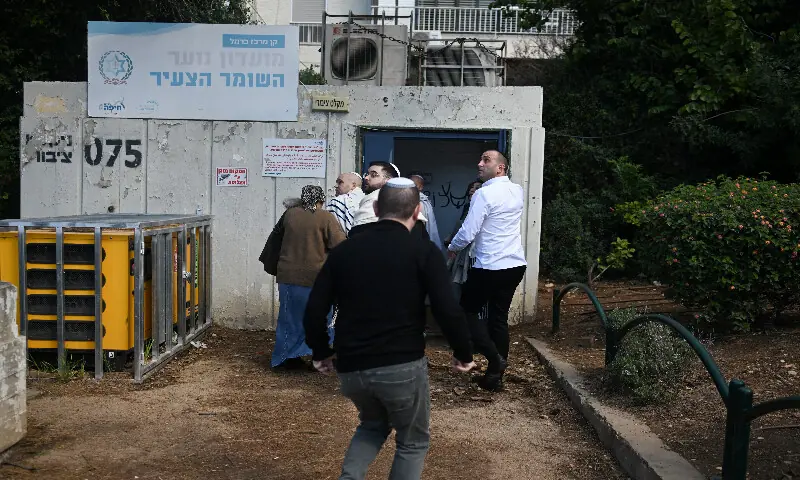
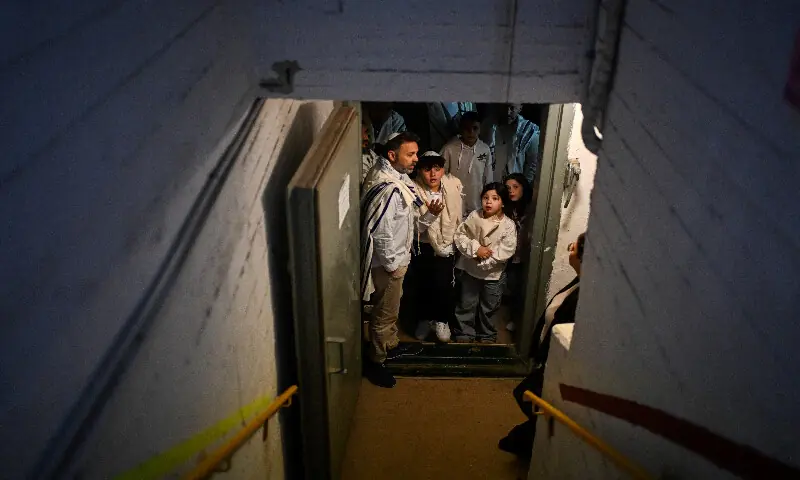
The Israeli military announced the closure of schools and workplaces, with exceptions for essential sectors, and a ban on public airspace.

Israel closed its airspace to civilian flights.

The US and Iran renewed negotiations in February to try to resolve the nuclear dispute.

Iran, which denies seeking atomic bombs, said it was prepared to discuss curbs on its nuclear programme in exchange for lifting sanctions but ruled out linking the issue to its missiles.

For the latest news, follow us on Twitter @Aaj_Urdu. We are also on Facebook, Instagram and YouTube.
Live

Airlines suspend Middle East flights after US, Israel strikes on Iran

Published 28 Feb, 2026 04:43pm 0 min read
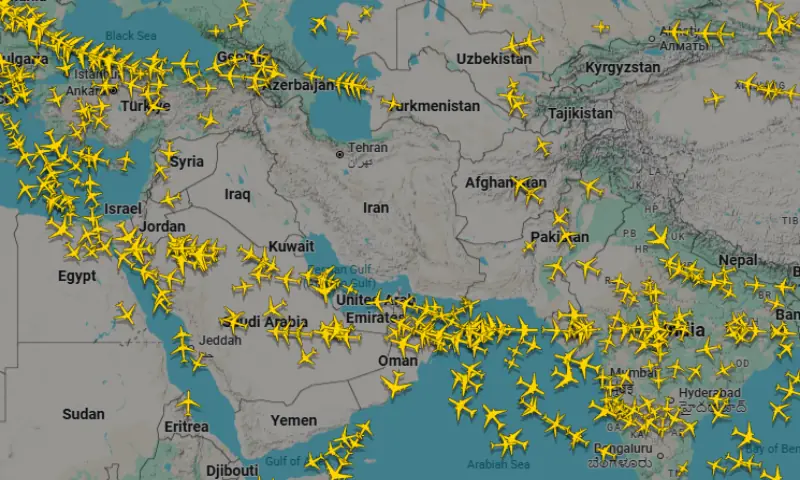
Airspace over Iran and Iraq has emptied after strikes, Flight Radar shows. – Reuters

Global airlines suspended flights across the Middle East on Saturday after the United States and Israel launched strikes on Iran, plunging the region into a renewed military confrontation.

Flight maps showed the airspace over Iran virtually empty as Israel said it struck Iran, and the US military initiated a series of strikes against targets in the country.

Iran retaliated with a salvo of missiles.

The escalation dimmed hopes for a diplomatic solution to Tehran’s nuclear dispute with the West and reignited conflict after weeks of US military buildup in the region.

It marks the latest upheaval for air travel in the usually busy region amid escalating tensions in the Middle East.

With Russian and Ukrainian airspace closed to most airlines due to years of war, the Middle East has become a more important route for flights between Europe and Asia.

Conflict zones are an increasing operational burden on airlines as aerial attacks raise worries about accidental or deliberate shoot-downs of commercial air traffic.

Longer flight times also require more fuel, adding to their costs.

Israel, Iran, Iraq and Jordan closed their airspace following the attacks, and a map of the region on Flightradar24 showed aeroplanes avoiding these areas.

Lufthansa, Wizz Air suspend flights

A number of Qatar Airways flights departed on Saturday morning, circled over Kuwait or Saudi Arabia before returning to Qatari airspace and were circling off Doha, according to Flightradar24.

The Russian Ministry of Transport said on Saturday that Russian air carriers had suspended flights to Iran and Israel.

Germany’s Lufthansa said it was suspending flights to and from Dubai on Saturday and Sunday and halting temporarily the Tel Aviv, Beirut and Oman routes until March 7.

Air France cancelled flights to and from Tel Aviv and Beirut.

Iberia also cancelled flights to Tel Aviv, while Wizz Air suspended flights to and from Israel, Dubai, Abu Dhabi and Amman with immediate effect until the same date, it said.

Kuwait’s aviation authority said it was halting all flights to Iran until further notice, according to the state news agency, while Oman Air said it had suspended all flights to Baghdad due to the regional developments.

The United Arab Emirates “partially and temporarily” closed its airspace as a precaution, its state news agency said.

“Due to the temporary closure of several airspaces in the region on 28 February, some flydubai flights have been impacted,” a spokesperson for the Emirati carrier said.

KLM, the Dutch arm of Air France-KLM, has brought forward the suspension of its Amsterdam–Tel Aviv service, cancelling the flight scheduled for Saturday after strikes in Iran, a spokesperson said.

The airline had announced on Wednesday that flights would be halted from Sunday, March 1.

Only one flight to Tel Aviv had been scheduled for Saturday.

Virgin Atlantic said it had decided to temporarily avoid Iraqi airspace, resulting in some re-routing of its flights.

Qatar Airways said it had halted air traffic temporarily as a precaution.

For the latest news, follow us on Twitter @Aaj_Urdu. We are also on Facebook, Instagram and YouTube.
Live

Iranians flee cities amid attacks by US and Israel

Published 28 Feb, 2026 04:28pm 0 min read
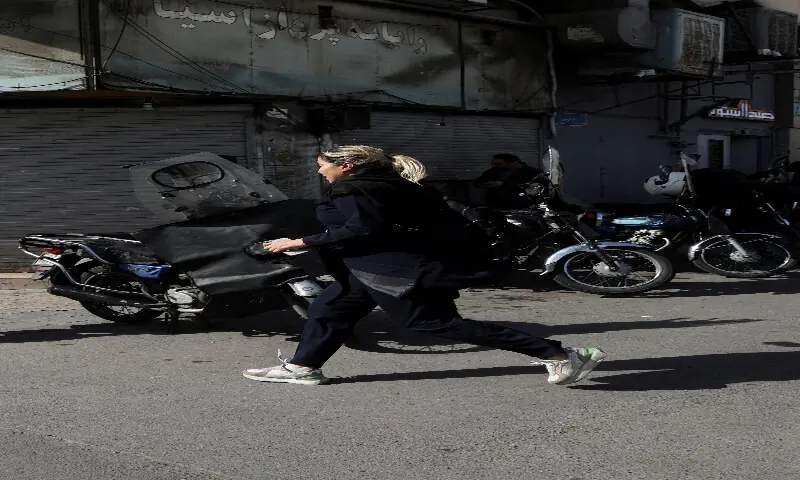
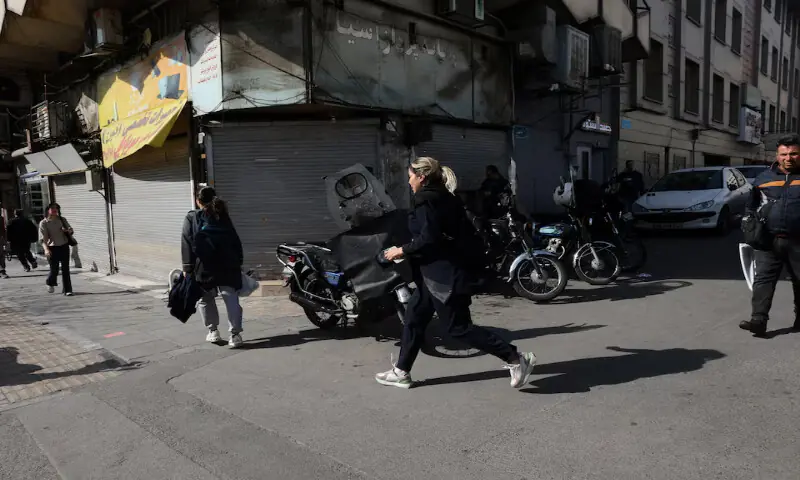
People run for cover following an explosion, after Israel said it launched a pre-emptive attack against Iran, in Tehran, Iran, on Saturday. – Reuters

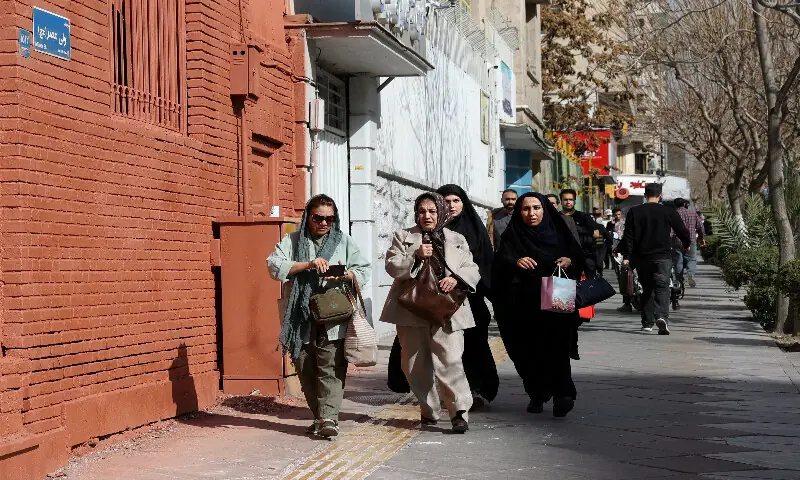
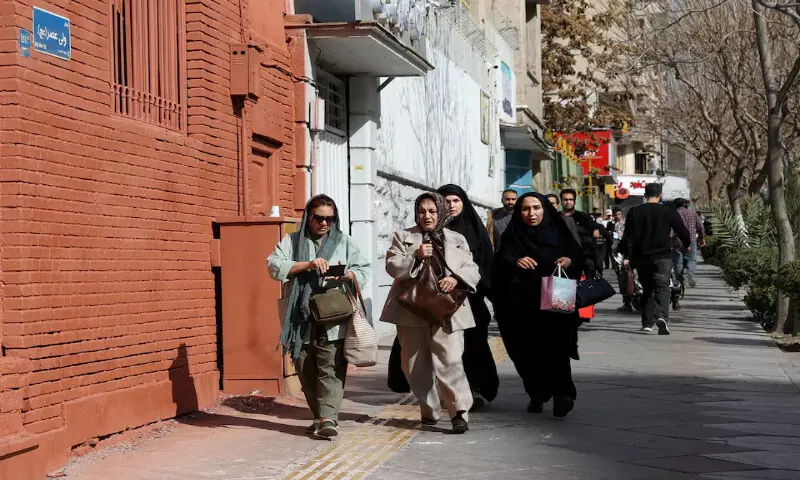
Long queues formed at gas stations and many Iranians began heading out of cities in search of safety, witnesses said, as an attack by the United States and Israel on Iran spread fear and panic throughout the country.

Explosions rocked Tehran and columns of smoke rose into the sky on Saturday morning, shaking the city at the start of the Iranian working week.

One man, speaking to Reuters from the capital, said he was rushing to get his children from school.

“We are scared, we are terrified. My children are shaking, we have nowhere to go, we will die here,” said Minou, a 32-year-old mother of two from the northern city of Tabriz, one of many areas where explosions were reported.

“What is going to happen to my children?” she said, crying as she spoke by phone.

Iran’s top security body said it expected attacks to continue in Tehran and some other cities, and therefore urged people to “travel to other cities where possible so that you may remain safe from the harm of these two regimes’ acts of aggression”.

Schools and universities would be closed until further notice.

The attack marks the latest upheaval for Iranians just weeks after nationwide unrest, and comes just eight months after last year’s 12-day war with Israel, during which the United States bombed Iranian nuclear sites.

US President Donald Trump said the operation would end a security threat to the United States and offer Iranians a chance to topple their rulers.

An Iranian from the central city of Yazd said he hoped that the attack would topple the clerical establishment that has run the country since the 1979 Revolution.

“Let them bomb,” the resident of Yazd said.

But Samira Mohebbi, speaking from the northern city of Rasht, disagreed.

“I am against this regime, to hell with them. But I don’t want my country to be attacked by foreign forces, I don’t want my Iran to turn into Iraq,” she said, referring to the neighbouring country that suffered years of chaos and bloodshed following the US-led invasion.

‘They fooled us again’

Security forces blocked roads in the area of Tehran that is home to the offices of Supreme Leader Ayatollah Ali Khamenei, President Masoud Pezeshkian, and parliament, witnesses said.

The attacks came after the latest round of negotiations between the United States and Iran in Geneva on Thursday failed to secure a breakthrough over Tehran’s nuclear programme, though Omani mediators had reported progress.

“They said the nuclear talks are going well. They fooled us again,” said a resident of Tehran.

Western governments have long suspected Iran aims to build a nuclear bomb. Tehran has always denied this.

Witnesses said people were rushing to buy hard currency.

In Isfahan, another area where attacks were reported, some said they were unable to withdraw cash from ATMs.

Reza Saadati, 45, said he was taking his family to the city of Urumieh near the Turkish border. “If the border is open, we will cross and then fly to Istanbul,” he said.

Mohammad Esmaili, 63, speaking from the town of Ilam, some 500 km from Tehran, said he would leave the town with his family.

“God knows what will happen to us. Pray for us,” he said.

A mother of three from Tehran said: “People are shocked, scared. What is going to happen to us? Save us please.”

For the latest news, follow us on Twitter @Aaj_Urdu. We are also on Facebook, Instagram and YouTube.
Live

Britain vows to defend interests as US-Israel strike hits Iran

Published 28 Feb, 2026 04:15pm 0 min read
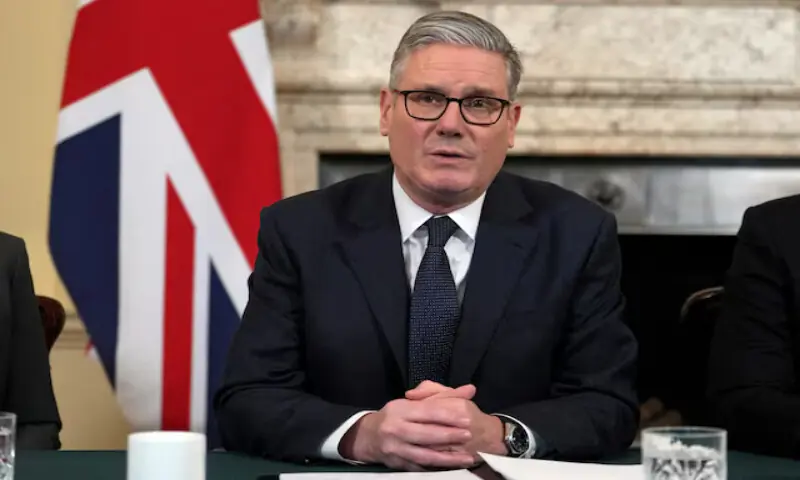
Britain’s Prime Minister Keir Starmer. – Reuters

Britain said on Saturday that Iran must never be allowed to develop nuclear weapons and stood ready to defend its interests, following strikes by the United States and Israel against Iran.

A government source said Britain had not taken part in the strikes, and that British Prime Minister Keir Starmer would hold an emergency response meeting, a so-called COBRA meeting, on Saturday.

“Iran must never be allowed to develop a nuclear weapon, and that is why we have continually supported efforts to reach a negotiated solution,” a government spokesperson said in a statement.

“As part of our longstanding commitments to the security of our allies in the Middle East, we have a range of defensive capabilities in the region, which we have recently bolstered. We stand ready to protect our interests,” the spokesperson said.

Britain does not want to see further escalation into a wider regional conflict, the spokesperson added.

Britain’s immediate priority was the safety of its nationals in the region, and it would provide consular assistance, according to the statement.

The government also issued a notice on Saturday advising against all travel to Israel and the Palestinian territories, after advising on Friday against non-essential travel in the regions.

For the latest news, follow us on Twitter @Aaj_Urdu. We are also on Facebook, Instagram and YouTube.
Live

US and Israel strikes threaten global energy supplies

Published 28 Feb, 2026 04:04pm 0 min read
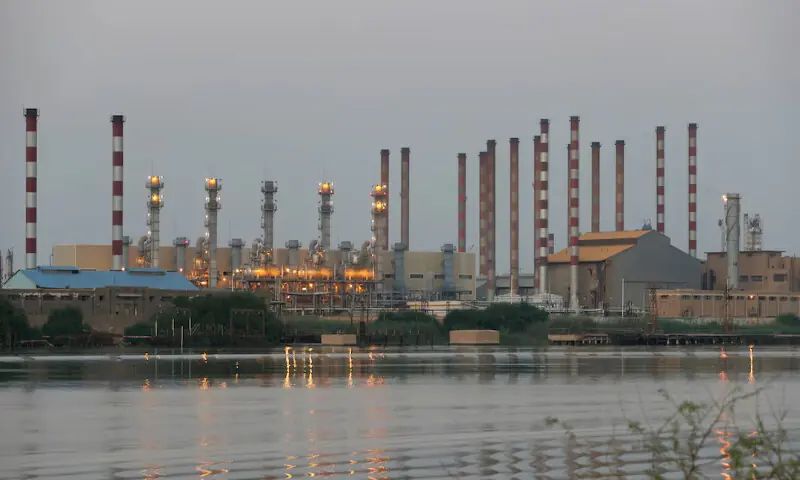
A general view of Abadan oil refinery in southwest Iran, is pictured from Iraqi side of Shatt Al Arab in Al Faw south of Basra, Iraq. – Reuters

The United States and Israel launched an attack on Iran on Saturday. The attack could disrupt oil and gas output and cause damage to energy infrastructure in the Middle East.

The following are facts on Iran’s energy industry, exports, and the impact of Western sanctions:

Oil production and infrastructure

Iran, the third largest producer in the Organisation of the Petroleum Exporting Countries, pumps about 4.5% of global oil supplies.

Iran’s output is about 3.3 million barrels per day of crude, plus 1.3 million bpd of condensate and other liquids.

Iran’s domestic refineries have a capacity of 2.6 million bpd, according to the consultancy FGE.

In 2025, it exported nearly 820,000 bpd of fuel, including LPG, according to Kpler, slightly below 2024 levels.

Iran’s oil and gas production facilities are concentrated in southwestern provinces: Khuzestan for oil and Bushehr for gas and condensate from South Pars.

It exports 90% of its crude via Kharg Island, for shipping through the narrow Strait of Hormuz.

Analysts say Saudi Arabia and other OPEC members could compensate for a drop in Iranian supply by using spare capacity to pump more, even though this spare capacity has been shrinking due to output increases the producer group has undertaken over the past year.

Who buys Iran’s oil?

Chinese private refiners are the main buyers.

The US Treasury has imposed sanctions on some Chinese refiners for purchases of Iranian oil.

China says it does not recognise unilateral sanctions against its trade partners, but its purchases of Iranian crude have declined.

As Iran also seeks to protect its stocks from potential US strikes, it has built p a record amount of oil on the water of about 200 million barrels, equivalent to about two days of global consumption, data from Kpler published on February 27 showed.

Iran has skirted sanctions for years by taking measures such as transferring oil from one ship to another at sea and changing the origin of the oil, to hiding tanker locations from satellites.

World’s largest gas reserve

Iran produces natural gas from the offshore South Pars gas field, which makes up around a third of the world’s largest reservoir of natural gas.

Iran shares the reservoir with major exporter Qatar, which calls its field the North Dome.

Sanctions and technical constraints have meant that most gas Tehran produces from South Pars is for domestic use.

Iran’s gas production totalled 276 billion cubic meters in 2024, with 94% consumed in Iran, according to data by the Gas Exporting Countries Forum.

Israeli attacks in June last year struck four units of Phase 14 of South Pars, around 200 kmfrom Qatar’s gas installations, many of which are joint ventures with energy giants ExxonMobil and ConocoPhillips of the US.

Qatar has made hundreds of billions of dollars exporting liquefied natural gas for nearly three decades.

The entire reservoir contains an estimated 1,800 trillion cubic feet of usable gas — enough to supply the entire world’s needs for 13 years.

For the latest news, follow us on Twitter @Aaj_Urdu. We are also on Facebook, Instagram and YouTube.

Live

Trump warns some Americans may die amid US strikes in Iran

Published 28 Feb, 2026 03:53pm 0 min read
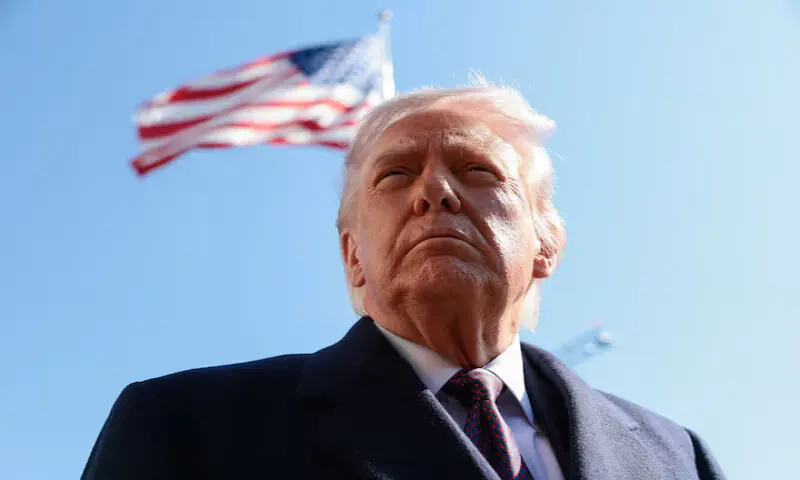
US President Donald Trump. – Reuters

US President Donald Trump said on Saturday that the United States had begun “major combat operations” in Iran, warning that there may be US casualties.

The strikes, which Trump said were aimed at destroying Iranian missiles and annihilating its navy, follow repeated US-Israeli warnings that they would strike Iran again if it pressed ahead with its nuclear and ballistic missile programmes.

“My administration has taken every possible step to minimise the risk to US personnel in the region. Even so, and I do not make this statement lightly, the Iranian regime seeks to kill,” Trump said in a video shared on Truth Social.

“The lives of courageous American heroes may be lost and we may have casualties that often happens in war, but we’re doing this, not for now. We’re doing this for the future, and it is a noble mission.”

Operation to last several days

The US military has named the operation “EPIC FURY,” the Pentagon said on X.

This is the second time the US has carried out strikes on Iran since Trump returned to the White House last year.

The first was in June when Washington carried out a series of attacks on Iranian nuclear sites.

Saturday’s strikes, unlike the first, are expected to be carried out over several days, a US official told Reuters.

Tehran is preparing for retaliation, with the response set to be crushing, an Iranian official told Reuters.

The Israeli military said that Tehran had launched missiles towards Israel in response.

In his message, Trump told the members of the Islamic Revolutionary Guard, Iran’s armed forces, to lay down their weapons, promising that they would be granted immunity.

The other option, according to Trump, is “certain death.”

Washington and Tehran held a series of talks in recent weeks about Iran’s nuclear ambitions.

The most recent one was held on Thursday with no deal.

“Iran refused, just as it has for decades and decades. They rejected every opportunity to renounce their nuclear ambitions, and we can’t take it anymore,” Trump said.

People urged to revolt

The president first floated the idea of strikes on Iran in January amid two-week-long nationwide protests.

He warned that the US would come to the rescue of protesters if Iranian officials were to shoot and kill them.

Trump later encouraged the protesters to continue protesting, saying that help was on the way.

Trump mentioned the killing of protesters during his statement on the strikes, telling Iranians to take cover because bombs will drop “everywhere.”

“When we are finished, take over your government. It will be yours to take. This will be probably your only chance for generations,” he said.


For the latest news, follow us on Twitter @Aaj_Urdu. We are also on Facebook, Instagram and YouTube.
Live

Iran strikes back: Missiles target US assets in Gulf

Published 28 Feb, 2026 03:04pm 0 min read

Tensions across the Middle East intensified on Saturday after Iran reportedly launched missiles at multiple locations in the region in response to US and Israeli strikes.

According to Al Jazeera, loud explosions were heard near the Al Udeid US military base in Qatar, and emergency sirens were activated in the surrounding area.

Qatari authorities have instructed residents to stay away from military installations and issued mobile phone alerts urging citizens to seek shelter in safe locations.

A foreign news agency, citing an official, reported that Qatar’s missile defence systems successfully intercepted and neutralised the Iranian missile attack.

In Bahrain, authorities confirmed that the headquarters of the United States Navy’s Fifth Fleet was targeted in a missile strike, according to Al Jazeera.

Meanwhile, Reuters reported a powerful explosion in Abu Dhabi, the capital of the United Arab Emirates.

Similar reports of loud explosions and the activation of warning sirens have also emerged from Kuwait.

Reports indicate that Kuwaiti forces intercepted Iranian missiles mid-air, with air raid sirens sounding in various areas.

Qatar, Kuwait, and the United Arab Emirates have reportedly closed their airspace amid the escalating situation.

In an interview with Al Jazeera, a senior Iranian official warned Israel to prepare for the response, stating that Iran’s response would be public and would involve “no red lines.”

The official further declared that all American and Israeli assets and interests in the Middle East are now considered legitimate targets.

He added that following the recent aggression, no red lines remain and all possibilities are on the table — including scenarios that had never previously been considered.

The Iranian official said the United States and Israel had initiated an act of aggression whose consequences would be broad and long-lasting.

He also stated that Iran was not surprised by the joint US-Israeli action and that its response would be comprehensive, with no specific timeframe attached.

For the latest news, follow us on Twitter @Aaj_Urdu. We are also on Facebook, Instagram and YouTube.
Israel, Iran war in pictures

Published 28 Feb, 2026 01:48pm 0 min read

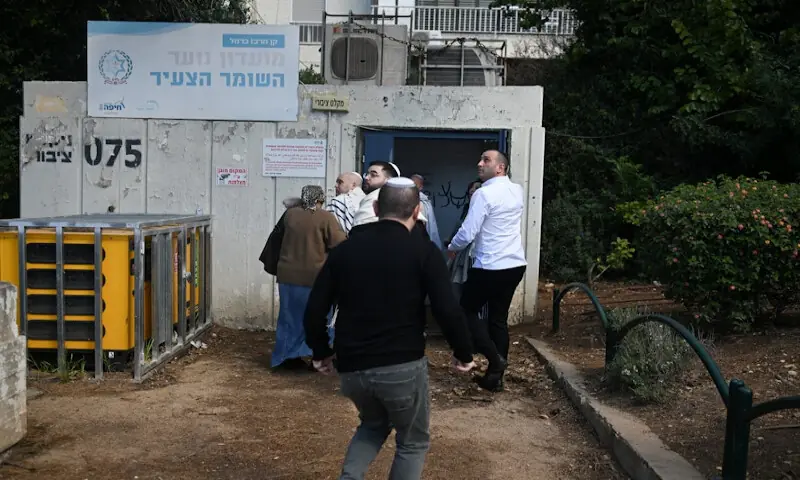
Israel said it launched a pre-emptive attack against Iran on Saturday, pushing the Middle East into a renewed military confrontation and further dimming hopes for a diplomatic solution to Tehran’s long-running nuclear dispute with the West.

For the latest news, follow us on Twitter @Aaj_Urdu. We are also on Facebook, Instagram and YouTube.
Live

Iranian state media hit by cyber attacks after military strikes

Published 28 Feb, 2026 01:28pm 0 min read
Picture for illustrative purposes only

Several Iranian state-linked news agencies and online platforms have been targeted by cyber attacks following US and Israeli military strikes on Iran, according to reports on Saturday.

The Telegram channel of the hard-line Hamshahri daily said a “widespread wave” of cyber operations had begun alongside the military escalation, disrupting a number of major media outlets in Iran.

Several platforms were reported to be experiencing technical difficulties or were temporarily inaccessible, the report said.

Preliminary reports cited by the channel indicated that the websites of the state news agency IRNA and the semi-official ISNA news agency were among those allegedly hacked or facing access problems.

The reports pointed to disruptions affecting several online applications across Iran. However, there were no clear details about who may be behind the attacks.

So far, Iranian authorities have not issued an official statement confirming the scale of the disruption.

For the latest news, follow us on Twitter @Aaj_Urdu. We are also on Facebook, Instagram and YouTube.
Live

US, Israel launch pre-emptive strikes against Iran

Updated 28 Feb, 2026 01:06pm 0 min read
Smoke rises following an explosion in Tehran, Iran, on Saturday. – Reuters
People run for cover following an explosion in Tehran, Iran, on Saturday. – Reuters
Smoke rises following an explosion in Tehran, Iran, on Saturday. – Reuters

Israel said it launched a pre-emptive attack against Iran on Saturday, pushing the Middle East into a renewed military confrontation and further dimming hopes for a diplomatic solution to Tehran’s long-running nuclear dispute with the West.

The New York Times, citing a US official, reported that US strikes on Iran were underway.

US strikes against Iran are being carried out by air and sea, a US official told Reuters on Saturday.

A source told Reuters that Iran’s supreme leader, Ayatollah Ali Khamenei, was not in Tehran and had been transferred to a secure location.

US President Donald Trump later confirmed on Saturday that the United States has launched “major combat operations” in Iran, following Israeli pre-emptive air strikes earlier in the day.

In an eight-minute video posted on his social media platform Truth Social, President Trump said the operations are aimed at eliminating imminent threats posed by the Iranian regime and preventing Tehran from acquiring nuclear weapons.

“Our objective is to defend the American people by eliminating imminent threats from the Iranian regime,” Trump said.

“Iran can never have a nuclear weapon. They are attempting to rebuild their nuclear programme and developing long-range missiles that threaten the United States and others.”

Trump added that the US military would target Iran’s missile capabilities, naval forces, and infrastructure, vowing to “destroy their missiles and raze their missile industry to the ground” while ensuring Iran cannot acquire nuclear weapons.

The attack, coming after Israel and Iran engaged in a 12-day air war in June, follows repeated US-Israeli warnings that they would strike again if Iran pressed ahead with its nuclear and ballistic missile programmes.

“The State of Israel launched a pre-emptive attack against Iran to remove threats to the State of Israel,” Defence Minister Israel Katz said.

An Israeli defence official said the operation had been planned for months in coordination with Washington, and that the launch date was decided weeks ago.

Explosions in many Iranian cities

Explosions were reported across multiple Iranian cities, according to local media.

The Fars news agency said blasts were heard in cities including Isfahan, Qom, Karaj, and Kermanshah.

In Tehran, several missiles reportedly struck University Street and the Republic area, with smoke rising over the city centre, the Islamic Republic News Agency reported.

The US operations mark a significant escalation in tensions following Israel’s confirmation of a pre-emptive strike against Iran, heightening concerns of a wider conflict in the region.

Tehran preparing for retaliation

Iran is preparing for retaliation after Israel launched an attack on Saturday, an Iranian official told Reuters.

The official said the response is set to be crushing.

Sirens in Israel

Sirens sounded across Israel around 08:15 local time in what the military said was a proactive alert to prepare the public for the possibility of an incoming missile strike.

The Israeli military announced the closure of schools and workplaces, with exceptions for essential sectors, and a ban on public airspace.

Israel closed its airspace to civilian flights, and the airport authority asked the public not to go to any of the country’s airports.

The US and Iran renewed negotiations in February in a bid to resolve the decades-long dispute through diplomacy and avert the threat of a military confrontation that could destabilise the region.

Israel, however, insisted that any US deal with Iran must include the dismantling of Tehran’s nuclear infrastructure, not just stopping the enrichment process, and lobbied Washington to include restrictions on Iran’s missile programme in the talks.

Iran said it was prepared to discuss curbs on its nuclear programme in exchange for lifting sanctions, but ruled out linking the issue to missiles.

Tehran also said it would defend itself against any attack.

It warned neighbouring countries hosting US troops that it would retaliate against American bases if Washington struck Iran.

In June, the US joined an Israeli military campaign against Iranian nuclear installations, in the most direct American military action ever against the Islamic Republic.

Tehran retaliated by launching missiles toward the US Al Udeid air base in Qatar, the largest in the Middle East.

Western powers have warned that Iran’s ballistic missile project threatens regional stability and could deliver nuclear weapons if developed. Tehran denies seeking atomic bombs.

For the latest news, follow us on Twitter @Aaj_Urdu. We are also on Facebook, Instagram and YouTube.